guides
How to Make Sauerkraut: One Cabbage, One Jar, Two Ingredients
Cabbage + salt + a week on the counter = real sauerkraut. The complete first-timer walkthrough — the 2% rule, the daily press, when it's done, and what every weird sight and smell means.
Honest disclosure: Some links below are affiliate links — Glivox earns a commission if you purchase, at no extra cost to you. We pay full price for products we review and rankings are never paid. Read the full policy.
There’s a reason sauerkraut is the traditional first ferment, taught before pickles, before kimchi, before anything in a crock: the cabbage does almost everything itself. It carries its own fermentation bacteria on its leaves. It makes its own brine when salted. It even packs itself down if you push occasionally. Your entire job is salt, pressure, and patience.
One medium cabbage and a tablespoon-and-a-bit of salt will teach you more about fermentation than any amount of reading — so this guide is built like the process itself: a walkthrough first, the science as you need it, and a field guide to every weird thing you’ll see in the jar.
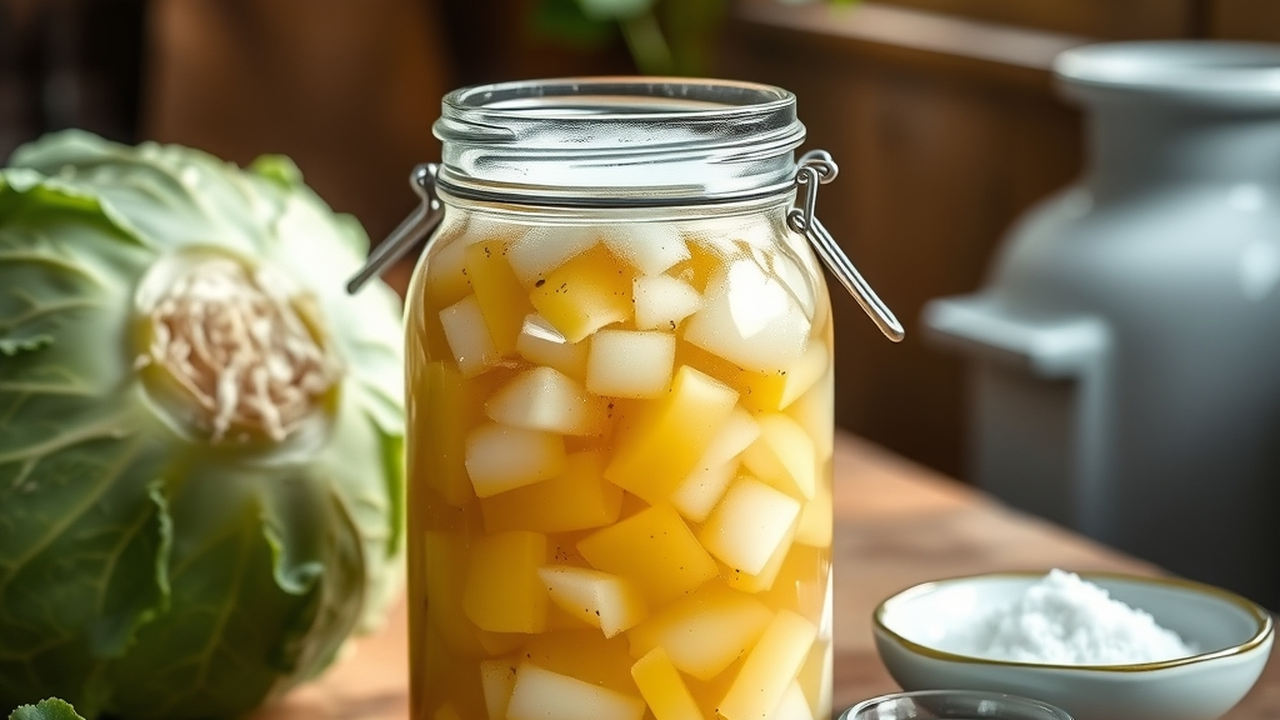
What you need (no special equipment, honestly)
- 1 medium green cabbage (~1.5 kg) — fresh and heavy for its size; late-season cabbages ferment best
- Non-iodized salt — sea salt, kosher, or pickling salt (iodine and anti-caking agents can slow the ferment)
- A wide-mouth glass jar (1–1.5 L) or any food-safe crock
- Something to weigh the cabbage down: a smaller jar that fits inside the mouth, a boiled stone in a zip bag, or a cabbage-core wedge
- A kitchen scale — the one strongly recommended item, because the whole craft is one number:
The 2% rule. Weigh your shredded cabbage; multiply by 0.02; that’s your salt in grams. (1,500 g cabbage → 30 g salt.) Get this number right and everything else forgives you. No scale? Roughly 1 tablespoon of fine salt per 800 g — workable, less reliable.
The walkthrough (30 minutes of work, then waiting)
1. Shred. Quarter the cabbage, cut out the core, slice into thin ribbons — knife, mandoline, whatever. Thinner ferments faster and packs tighter. Keep one large outer leaf aside.
2. Salt and squeeze. Toss shreds and salt in a big bowl, then massage and squeeze hard with your hands for 5–10 minutes. Something slightly magical happens: the salt pulls water out and the bowl fills with brine — the cabbage literally producing the liquid it will ferment in. When you can grab a fistful and squeeze out a visible trickle, it’s ready. (Arm tired? Cover the bowl and walk away for an hour — the salt keeps working without you.)
3. Pack. Stuff the cabbage into the jar a handful at a time, pressing down hard with your fist after each addition so brine rises above the shreds and air pockets collapse. Pour every drop of bowl-brine on top. Leave 4–5 cm of headspace — fermentation foams.
4. Submerge — the one law of fermentation. Lay the reserved outer leaf on the surface like a lid, and set the weight on it so everything sits below the brine line. Above the brine is where mold lives; below it, the salt-and-acid environment lets only the good bacteria work. Every fermentation failure story starts with something poking out of the liquid.
5. Cover loosely — a lid barely screwed on, or a cloth and rubber band. Gas must escape; airborne visitors must not enter. Park the jar on a plate (overflow happens) somewhere out of direct sun, ideally 18–22°C.
6. The daily ten seconds. For the first week: press the weight once a day (re-submerges everything, burps gas) and taste from day 4 or 5 onward with a clean fork. That’s the whole maintenance schedule.
When is it done? (Whenever you say so)
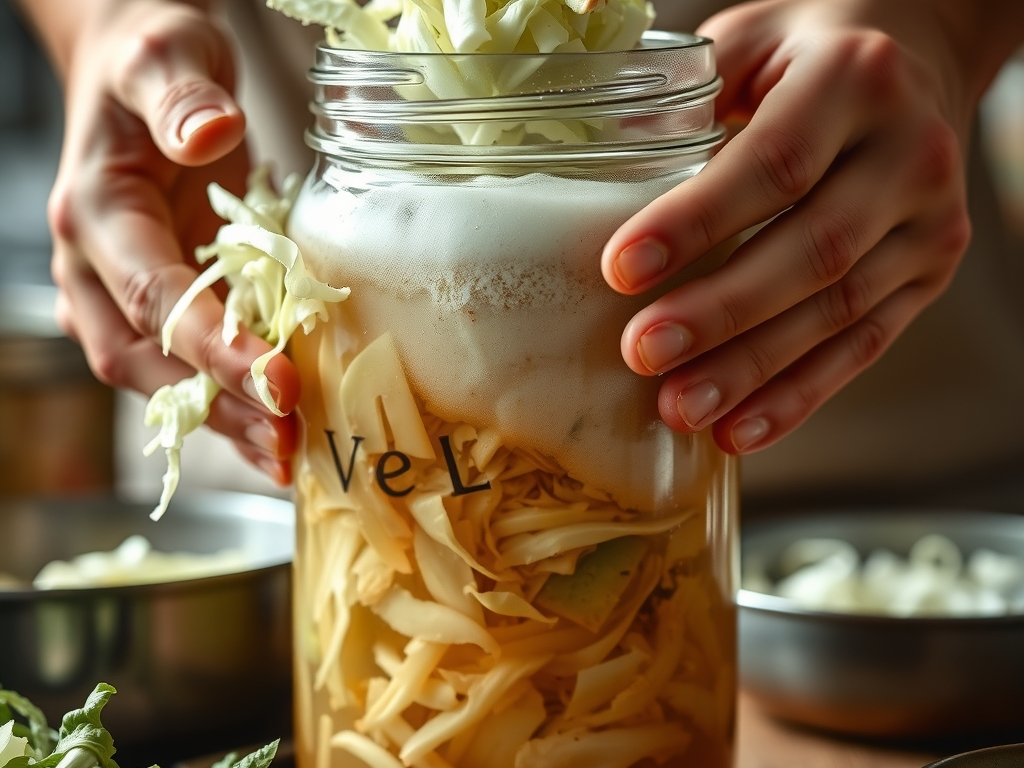
Sauerkraut has no finish line — it has a flavor dial. Around day 5–7 it’s mild, barely tangy, still crunchy. By week 2 it’s recognizably kraut. By week 3–4 it’s the full deli-sour, softer texture, deeper funk. Cold-country tradition ferments for six weeks and more. When the taste makes you happy, move the jar to the fridge — cold all but stops the ferment, and it keeps there, submerged, for months (properly made kraut in the fridge outlasts most people’s patience by half a year).
The jar tells you it’s working: brine turns cloudy (day 2–3 — this is correct, not a problem), bubbles rise when you press (the bacteria breathing), and the smell shifts from cabbage → sharp → pleasantly sour-pickled. If your kitchen runs hot, everything happens faster; cool, slower. Neither is wrong.
The field guide to weird (what every sight and smell means)
- Cloudy brine, white sediment at the bottom → normal. That’s yeast and bacterial activity, the sign of life.
- Foam or scum on the surface → skim it, press everything back under, carry on.
- A white film on the surface (flat, matte) → kahm yeast: harmless, common in warm kitchens. Skim what you can, don’t panic, maybe move the jar somewhere cooler.
- Fuzzy spots — blue, green, black, pink → actual mold, and the honest answer is the strict one: it means something sat above the brine. Small-batch home rule: discard and restart — a cabbage costs $2, and your next batch will be submerged properly.
- Smells sour, sharp, sulfurous-cabbagey in week one → all within normal. Smells genuinely putrid (you won’t wonder — you’ll know) → the salt ratio or submersion failed; discard. This distinction is dramatic and unmistakable in practice.
- Pink kraut (not from red cabbage) → yeast from too much salt or uneven mixing; the classic advice is discard.
- Too soft/mushy at the end → usually too warm or too little salt; still safe, just texture. Ferment the next batch cooler.
Worth saying plainly: properly salted, properly submerged vegetable ferments have an extraordinary safety record — the acidity that develops is the same preservation principle canning works so hard to guarantee, produced biologically. Follow the 2% and the submersion law, and the scary scenarios stay theoretical.
Where kraut fits in the bigger harvest picture
A fall cabbage glut is the classic kraut trigger — two big heads become a half-year of condiment in one afternoon, no freezer space, no canner, no equipment the kitchen doesn’t already own. Once the basic move clicks, the same 2%-salt-and-submerge pattern turns cucumbers into real pickles, carrots into sour sticks, and jalapeños into hot-sauce mash — that whole map is in the fermentation starter guide.
What works
- Weigh the cabbage, salt at 2% - the entire craft in one number
- Squeeze until brine trickles; the cabbage makes its own liquid
- Everything below the brine line, always - the one law
- Taste from day 5; fridge it whenever YOU like the flavor
What doesn't
- Iodized table salt (slows the ferment; use sea/kosher/pickling)
- Loose packing (air pockets = off-flavors and surface growth)
- Screwing the lid tight (ferments make gas; loose lid or cloth)
- Panicking at cloudy brine (that IS fermentation working)
FAQ
What is the ratio of salt to cabbage for sauerkraut?
Two percent by weight: weigh the shredded cabbage and multiply by 0.02 to get salt in grams — 1,500 g of cabbage takes 30 g of salt. This ratio is the entire recipe: enough salt to suppress the wrong microbes and keep the kraut crisp, little enough that the fermentation bacteria thrive. A kitchen scale makes it exact; without one, about 1 tablespoon of fine non-iodized salt per 800 g of cabbage is a workable approximation. Use sea, kosher, or pickling salt.
How long does sauerkraut take to ferment?
It’s a flavor dial, not a deadline: mild and tangy at 5–7 days, classic kraut around 2 weeks, deep deli-sour at 3–4 weeks, with cooler rooms running slower and warmer rooms faster. Taste it every few days from day 4–5 with a clean fork and refrigerate the jar whenever the flavor suits you — cold essentially stops the ferment. There’s no point where it’s “ready”; there’s a point where it’s yours.
Why does my sauerkraut have white film or cloudy brine?
Cloudy brine with pale sediment is fermentation itself — expected from day 2–3 and a good sign. A flat white surface film is usually kahm yeast: harmless, more common in warm kitchens; skim it, re-submerge everything, and continue. The one to respect is fuzzy colored growth (blue, green, black, pink), which means material sat above the brine — for a $2 home batch, the honest rule is discard, fix your weight setup, and restart. Submersion prevents essentially all of it.
Is homemade sauerkraut safe?
Properly made — 2% salt, everything held under the brine — vegetable fermentation is among the safest food preservation methods there is, with an exceptional record: the process rapidly creates an acidic environment hostile to dangerous organisms, the same acidity principle that makes pickling and canning safe, generated biologically. The failure signs are obvious rather than hidden (visible fuzzy mold, genuinely putrid smell), unlike the invisible risks improper canning can carry. Follow the two rules and trust your nose and eyes.
Two ingredients, one law, and the cabbage does the rest — start a jar this weekend and taste it change all week.
Keep reading
guides
How to Preserve Your Vegetable Harvest (2026 Beginner's Guide)
Drowning in tomatoes and zucchini? A beginner's guide to preserving your vegetable harvest — freezing, canning, drying, root storage and fermenting, and which method suits each crop.
guides
Canning Safety 101: The Rules That Actually Keep Home-Canned Food Safe
Water bath vs pressure canning, the acid rule, botulism facts without the panic, and the 7 non-negotiable rules — a beginner's guide to canning food safely at home.
guides
Fermentation for Beginners: Sauerkraut, Pickles, and the Salt Math That Keeps It Safe
Turn cabbage and cucumbers into tangy, probiotic food with salt and time. The 2% rule, the submersion rule, and what's normal vs what to toss — honestly explained.